All Recurring Bills & Subscriptions, that are monthly are calculated by 13 months instead of 12.

I know there was a previous issue for this that was closed, and the response was that the formula is more complex then just the (monthlyAmount * 12 = yearly). But the problem is that the complex formula is producing incorrect results. For example I pay 3.21 a month for "Amazon Prime No-Ads". My expectation is that the yearly for this would be 3.12 * 12 = 38.52, but I'm actually getting $41.73. I have no current transactions for this as this doesn't get billed until the end of the month.
I'm seeing this for every single one of my monthly recurring bills and subscriptions.

In what world does a $1000 monthly payment = $13,000 yearly? I have no current transactions for this amount, and there are only 12 months in a year, so am I unreasonable in expecting this to be $12,000 yearly?
I would also argue that it doesn't make since to have this be calculated any way other than the monthlyAmount * 12. Any other way of calculating the yearly total for that column doesn't make since unless it's clearly communicated what the formula is so that users can take that into account. But I think a reasonably user would expect to see yearly total of the monthlyAmount * 12.
Also, I entered a new recurring bill a couple day's ago, in December, but the first payment wasn't due until the end of January. The bill was for $160.92 a month, and I would expect the yearly to show $1931.02, but the tool showed $0.00 Yearly. I'm guessing because there was $0 due in 2025. Again, that doesn't make any sense to me as there is nothing on this page that gives any context or direction as to why I'm seeing what I'm seeing. It feel's like numbers pulled out of a magic hat that are in no way helpful or acurrate.
Perhaps a more helpful solution would be a toggle between 12 month total, and total for current year?
Comments
-
Yes, it's disconcerting, and it has been commented upon before. The quarterly and yearly seem to be right but monthly can vary. I will be honest that I pay little attention to that amount as it doesn't make any difference to my Spending Plan.
Here's the official answer from another conversation with Coach Natalie about a year or so ago:
"Hey again, I already heard back on this and it sounds like 'Yearly' totals are not derived by a simple multiplication. This is what our product team said: "For the yearly calculation, we do it slightly differently than multiplying the recurring amount by 12 months. We calculate the amount based on how many posted transactions exist for the recurrence + the amount of future scheduled transactions for the rest of the calendar year multiplied by the amount."
You can read the whole conversation here:
Steve
Quicken Simplifi (Safari & iOS) Since 2021
Quicken Classic (MacOS) Since 2009
MS Money (1991-2009) and Dollars & Sense (1987-1991)1 -
Yes, I saw that previous conversation as well, but the answer does not make sense to me and still does not account for the the fact the the "Yearly" amount is the total of 13 months and not 12. So, to me it seems there is a bug in their formula that it causing incorrect calculations.
0 -
@Chris Carrick, thanks for reaching out to the Community!
When this was inquired about in the past, we were told it's by design. If you'd like to request a change to the design, you may do so by creating an Idea post. Idea posts allow other users to vote for your requested change, which allows our product team to understand pain points and see how many users would like to see the change made.
I hope this helps!
-Coach Natalie
0 -
@Coach Natalie Would you mind reaching out to your product team and verifying that this is actually according to design? I find it hard to believe that a yearly total of monthly recurring bills/subscriptions should under any circumstance equate to anything greater than 12 months, which is what it is doing.
The previous post on this said: "we calculate the amount based on how many posted transactions exist for the recurrence + the amount of future scheduled transactions for the rest of the calendar year multiplied by the amount." Which in my case should mean:
Posted Transactions Total for 2026 = $0.00 (unless it's including December 2025? Which…why would that be according to design?)
Number of future scheduled Transactions = 12
Transaction Amount = $3.21
So I would expect based on the response: $0.00 + (12 * 3.21) = $38.52But I'm actually seeing: $41.73

I hope you're not telling me that this is actually according to design, and if it is I'd love to have a chat with the product team to understand how they could possibly think this is working correctly.
Again this is only for monthly transactions that I'm seeing this issue. Quarterly and Yearly appear to work as expected. So I really, really, REALLY, think this is a bug that should be addressed, and not a feature request.1 -
[EDIT: I see @Chris Carrick posted almost exactly the same thing a couple of minutes before me.]
FYI, my quarterly bills, and bills with multiple fixed dates, don't show a correct yearly projection either. This is a good time to bring this up, because most quarterly bills have not had any payments so far and it's easier to show that the explanation given to @Coach Natalie by the product team is incorrect.
For example, I have a quarterly bill for $50, with the first payment this year scheduled for January 18, that is showing $250 for the year.

And I have $690 bill with 4 fixed dates, non of which have occurred so far this year, that is showing $3450 for the year.
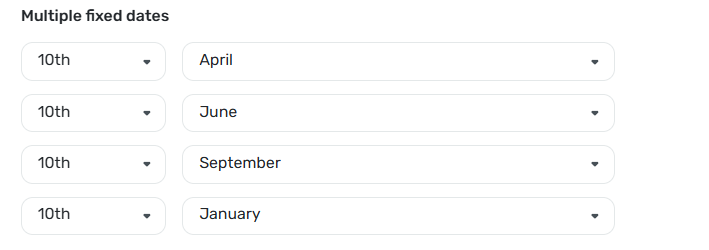

The product team told Coach Natalie that:
"We calculate the amount based on how many posted transactions exist for the recurrence + the amount of future scheduled transactions for the rest of the calendar year multiplied by the amount."
But this is January 2 and neither of these bills has any posted transactions so far this year. So for both of these cases the "how many posted transactions exist" factor equals zero.
And in both cases the "amount of future scheduled transactions" factor equals four. (One bill is quarterly and the other bill has four listed fixed dates for the year.)
So for both cases the formula described should work out to ((zero + four) * the amount of the bill).
Yet in both cases the actual amount shown is (five * the amount of the bill).
DryHeat
-Quicken Classic (1990-2020), CountAbout (2021-2024), Simplifi (2025-…)1 -
@Chris Carrick, thanks for the reply!
When this was inquired about previously, it was for the exact same behavior—yearly amounts showing the monthly amount multiplied by 13 instead of 12. While I agree that the description provided doesn’t fully make sense, there is clearly more involved in these calculations than a simple multiplication.
At this time, the most effective way to get a suggested change in front of the product team is to create an Idea post, as mentioned earlier.
I apologize that I don’t have a more definitive answer to share right now, but we’ll be on the lookout for your Idea post.
If you’d like a second opinion in the meantime, you’re also welcome to reach out directly to our Chat or Phone Support Team:
-Coach Natalie
0 -
@DryHeat Interesting and weird. I only have 2 quarterly recurring, one for my IRS Payments, and it is 4x the amount and another for Waste Management, which is also correct:

Here is a quarterly one for my prescription (I have it set for 84 days because they fill it 6 days early or some such. I don't know why I bothered):

And here is one of the few monthly ones, that is right, but I think it is because I just paid it for January.

Edit: I cannot believe we spend $1K for TV that I don't even watch.
Steve
Quicken Simplifi (Safari & iOS) Since 2021
Quicken Classic (MacOS) Since 2009
MS Money (1991-2009) and Dollars & Sense (1987-1991)1 -
@Coach Natalie, @Chris Carrick
I understand that the product team has designed a special method of calculating yearly totals. So the totals we see are the result of a design choice. And that design choice makes sense in certain circumstances.
So this would not be a bug … if it were working as designed.
But the totals are not being calculated according to that special method. (See Chris & my posts above.)
So wouldn't that be a bug? The fact that it is not working as designed? Is that not something you can report?
DryHeat
-Quicken Classic (1990-2020), CountAbout (2021-2024), Simplifi (2025-…)0 -
Are ideas less likely to get fixed than bugs? Or more likely?
Maybe if the coaches could convert a bug report / discussion to an idea post instead of suggesting to create a brand new post it would reduce some of the friction and effort that we paying customers need to put in in order to make these requests. This seems to come up a lot in my opinion.
0 -
I don't have any inside knowledge of how the Simplifi team deals with bugs vs. ideas. When I was developing software, bugs were on the inside track to get looked at and classified (type/severity) before new ideas.
This issue looked like a bug to me until I read @Coach Natalie's post explaining the way the product team looked at the issue. Their method made good sense to me -- at least until I looked deeper and discovered that it didn't really work that way.
So now I'm back to viewing it as a bug, but one that I can easily work around by ignoring the monthly totals that Simplifi displays. For me, it is pretty low impact and not much of a priority.
DryHeat
-Quicken Classic (1990-2020), CountAbout (2021-2024), Simplifi (2025-…)1